Platform 01 — Active Development

Modular food infrastructure built on HexPod architecture. Designed for homes, remote communities, industrial sites, harsh environments, and the long-term pathway toward space-forward habitation.

640W
PSU Architecture
IPC-3
Electronics Grade
3rd
ISDC 2026 Rothblatt

What Is
SolVita Gardens?

SolVita Gardens is OmniForge Dynamics Inc.'s flagship platform — a modular controlled-environment food infrastructure platform designed to make food production more predictable, local, automated, and deployable. It is being built to operate across homes, remote communities, industrial sites, military environments, research locations, and eventually space-forward habitats.

SolVita Gardens is not a smart garden appliance. It is food infrastructure — built with the architecture, electronics standards, and serviceability required for long-duration, harsh-environment, and eventually off-world deployment.

"Food sovereignty is an infrastructure problem. SolVita Gardens is the infrastructure."

— OmniForge Dynamics Inc.

SolVita Gardens placed 3rd at the ISDC 2026 Rothblatt Business Plan Competition, validating both the technical approach and the commercial opportunity on the international stage. Its electronics are specified to IPC Class 3 + Space Addendum manufacturing standards — not as a future aspiration, but as the current design baseline.

Built on
HexPod Architecture.

HexPods are the modular growing cells that form the foundation of the SolVita Gardens platform. One SolVita Gardens unit is made up of multiple HexPods — each one a standardized, repeatable growing zone with its own controller, sensors, lighting, and nutrient delivery. The same modular thinking carries through every product tier, from Alpha to Omega.

HexPod
Alpha
Epsilon
Omega
For Customers

Simple, modular growing zones that make controlled-environment food production easier to manage, monitor, and expand. Add capacity one HexPod at a time. Service one module without taking down the whole system.

For Partners

Configurable modular architecture with per-pod data, maintenance access, and deployment-specific configurations. Scale installations from a single unit to a multi-tier bank. Designed to support field serviceability at the module level.

For Investors

A hardware-platform model built for repeatable manufacturing and scaling. Multiple product tiers — Alpha, Epsilon, Omega — all share the same HexPod core architecture. Potential recurring revenue pathways through replacement modules, consumables, software subscriptions, and service agreements.

Alpha.
Epsilon.
Omega.

Three deployment tiers, one shared modular architecture. Each tier extends the platform into new environments and scales HexPod capacity to match the mission.
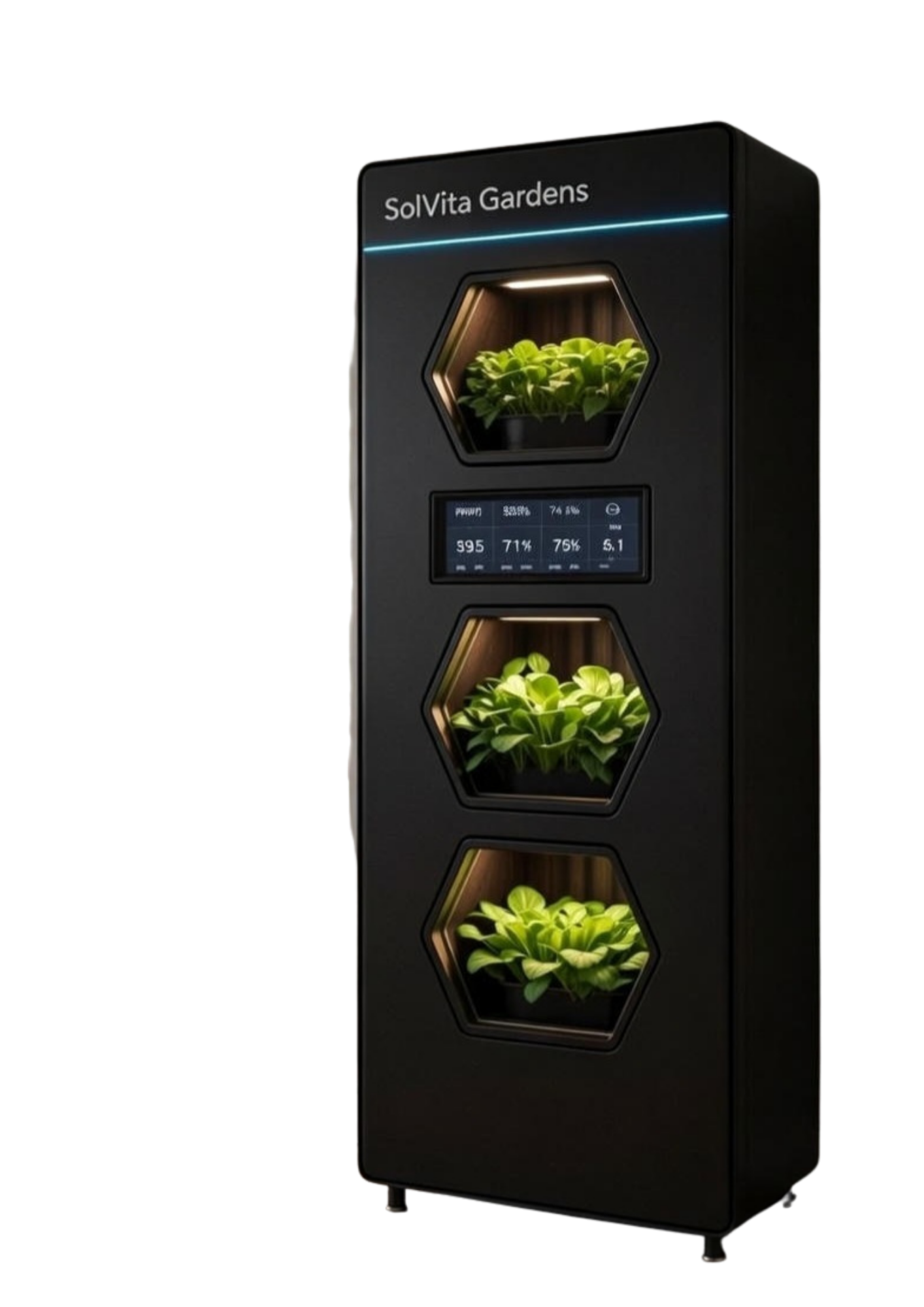
Alpha
Entry-Level · Early Market
HexPod Capacity [[UNCONFIRMED: 3 HexPods per unit]]
SolVita Gardens Alpha unit

Alpha is the platform's first deployment layer — designed to validate the core growing architecture, user experience, automation system, and modular service model in homes and light-commercial environments. Accessible, automated, and designed for users who want real food production without operational complexity.
Home Prosumer Restaurants & Food Service Education Early Validation Pilots
Epsilon
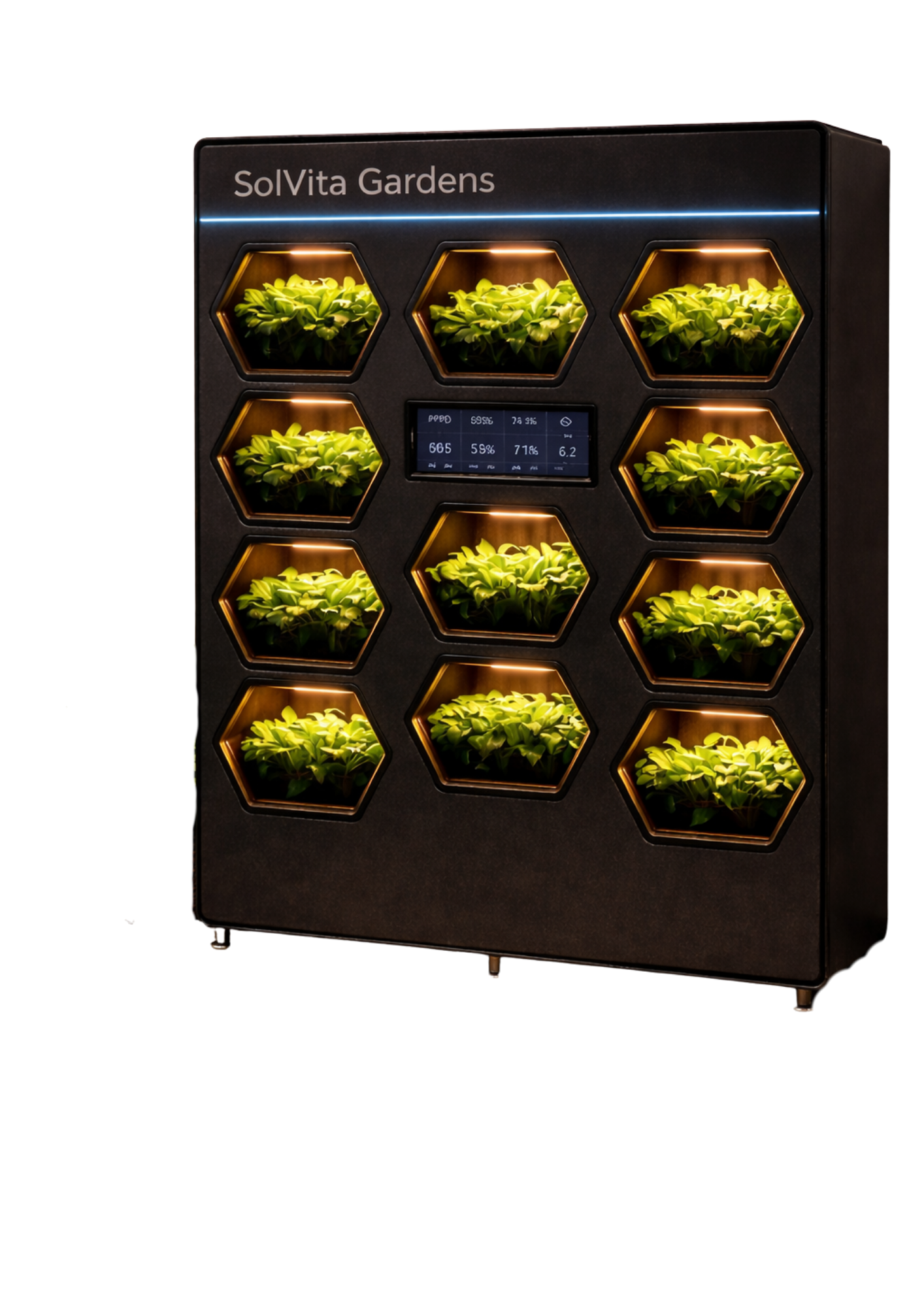
Rugged · Remote Deployment
HexPod Capacity [[UNCONFIRMED: 9 HexPods per unit]]
SolVita Gardens Epsilon unit

Epsilon extends the platform into rugged and remote environments — being developed for food production where logistics, climate, and infrastructure limitations make fresh supply difficult or impossible. Designed for lower operator burden, field serviceability, and reliable operation in harsh conditions.
Remote & Northern Communities Arctic Bases Military Complexes Mining & Industrial Camps Oil & Gas Disaster Relief Research Stations
Omega
Space-Forward Vision
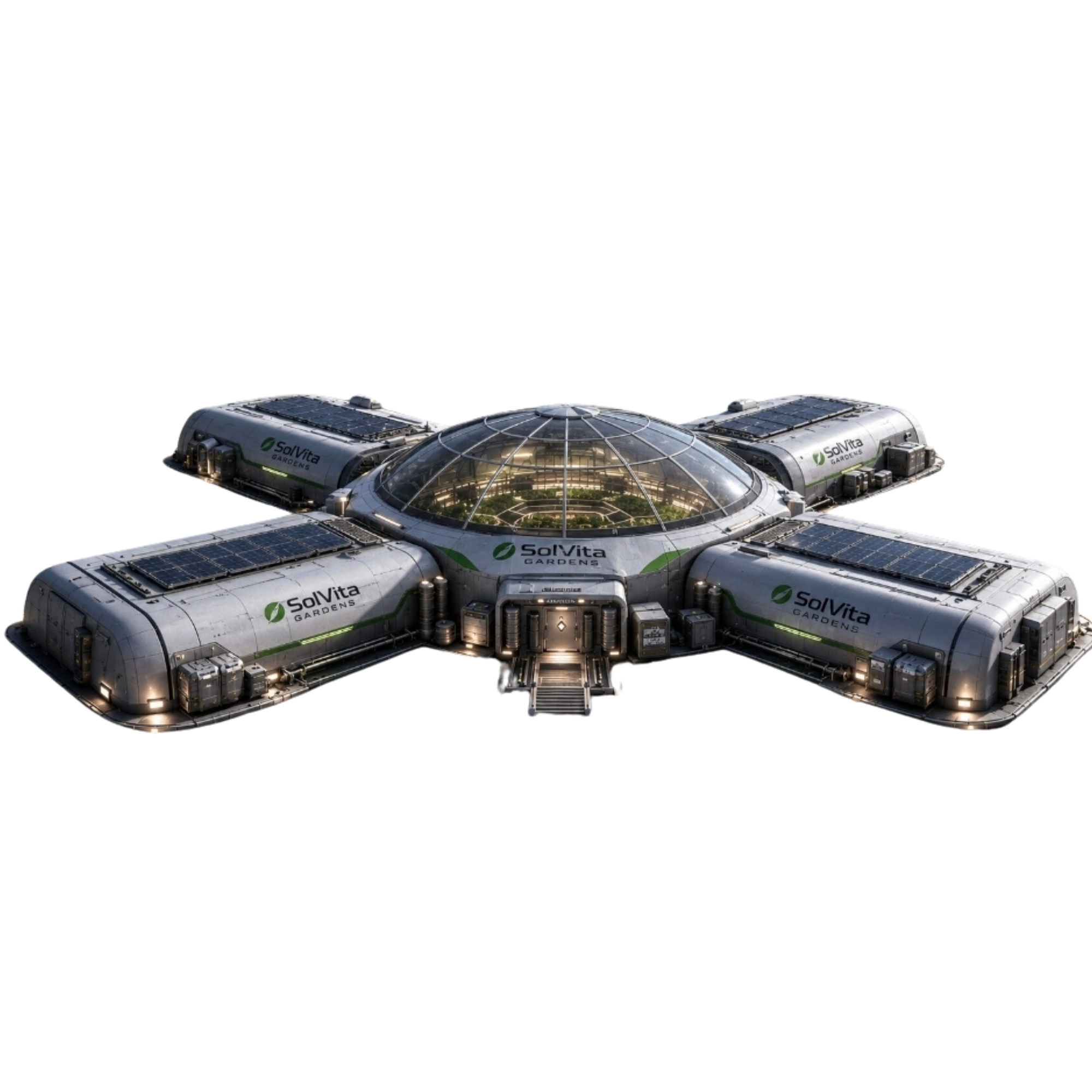
HexPod Capacity [[UNCONFIRMED: ~40 HexPods per petal · ~160+ total across all petals]]
SolVita Gardens Omega habitat concept

Omega represents the long-term space-forward evolution of the SolVita Gardens platform: a modular habitat-scale food production system designed around the future needs of closed environments, analog missions, and off-world infrastructure. The concept centers on a central glass-domed atrium hub with four attached farm petals, white/gray aerospace exterior, integrated solar panels, and a mission identity built for 4–8 crew operations. It combines food production, habitat support, and life-support-adjacent infrastructure.

Omega is a design concept and roadmap vision, not a currently certified or commercially deployed product. Development is intended to progress through an Earth-first validation pathway toward analog mission and off-world applications.

Space Analog Missions Future Orbital Applications Long-Duration Habitation Closed-Environment Operations

Where
SolVita Gardens Operates

Homes & Prosumers

Year-round growing for households that want reliable, fresh food production independent of season, supply chains, or geography.

Restaurants & Food Service

Specialty herbs, greens, and produce grown on-site for hyper-local supply with full traceability and reduced logistics dependency.

Remote Communities

Northern and isolated communities where cold-chain logistics are expensive, unreliable, or seasonally disrupted. Designed to support local fresh food access.

Arctic & Northern Operations

Extreme-climate deployments at research stations, resource extraction sites, and permanent northern infrastructure where food supply is a persistent operational challenge.

Military Bases

Forward operating bases and remote installations seeking reduced supply chain dependency and increased operational food resilience.

Mining & Industrial Camps

Remote resource extraction sites with large workforces and high food logistics costs. Intended to improve food access and reduce supply chain exposure in harsh camp environments.

Disaster Response

Rapid-deployment food production for humanitarian contexts where conventional supply chains have been disrupted by disaster, conflict, or infrastructure failure.

Research Stations

Scientific and life sciences research requiring controlled-environment food systems for astrobotany, closed-loop ecology, and long-duration habitat studies.

Space Analog Missions

Earth-based analog habitat simulations and isolated long-duration research programs requiring food infrastructure that mirrors the constraints of future off-world environments.

Future Orbital & Lunar Habitats

Roadmap toward in-situ food production for future crewed missions and off-world installations — reducing Earth resupply dependency and supporting long-duration human presence.

Food as
Infrastructure.

Modern food systems depend on long supply chains, stable weather, reliable logistics, and centralized distribution — all of which are vulnerable to climate stress, transport disruption, remote-access challenges, rising costs, and geopolitical instability. For the people who live and work furthest from those systems, the fragility is not a future risk. It is a daily operational reality.

01
Supply Chain Fragility

Global food distribution relies on just-in-time logistics networks vulnerable to fuel costs, weather events, labor disruption, and geopolitical risk. Single-point failures ripple through entire regional food supplies.

02
Remote Access Gaps

Northern communities, remote industrial sites, military installations, and isolated settlements face structurally higher food costs, reduced variety, and seasonal or logistical access failures — regardless of global food production levels.

03
Climate Stress

Conventional agriculture is increasingly exposed to drought, flooding, heat stress, and shifting growing seasons. Controlled-environment production is designed to decouple food production from weather dependence.

04
Off-World Habitation

For permanent remote operations and future space habitation, food cannot remain only a shipped consumable. Every kilogram launched from Earth represents a cost, a risk, and a dependency. In-situ food production is not optional — it is infrastructure.

Earth First.
Then Further.

SolVita Gardens is built around an Earth-first validation strategy — deploy, validate, and ruggedize on Earth before extending toward remote, harsh, and eventually space-forward environments. Every technical decision made at the electronics level is intended to support future qualification for more demanding environments.

01
Current
Earth-Based Validation
2025–2026 · Active Phase
Hardware design specification locked. Manufacturing partner LOI signed. Competitive validation at ISDC 2026. Building the foundation for remote and ruggedized deployment.
HDS Rev B — 27-page specification locked across two PCBs
Manufacturing LOI signed with multiple international partners (ISO-certified PCBA)
3rd place — ISDC 2026 Rothblatt Business Plan Competition
Fabrication partner LOI — in process
$50K investment raise — open
02
Near-Term
Ruggedization & Remote Deployment
2026–2027 · Pre-Commercial
Intended to extend the platform into remote and harsh-environment deployment — validating reliability, serviceability, and operator experience under real-world field conditions.
Prototype completion and functional validation
Epsilon hardware ruggedization specification
Resolve six HDS Rev B open gating items
Remote community pilot deployment program — development intended
Parylene C conformal coating qualification — planned
03
Mid-Term
Analog & Research Testing
2027–2029 · Pathway Stage
Designed to support deployment in analog habitat environments and research institutions as a precursor to space-forward qualification. Intended to build the operational record required for more demanding environments.
Analog habitat deployment partnership — development intended
Space life sciences and astrobotany research collaborations
Closed-loop nutrient and water system optimization
Vacuum and thermal cycling test protocol — intended
Radiation tolerance characterization — intended
04
Long-Term
Space-Forward Integration
2029+ · Roadmap Vision
Omega represents the long-term space-forward roadmap: a modular habitat-scale food system intended for analog missions and eventually off-world infrastructure. Designed to support crew food production in closed environments where Earth resupply is constrained.
Space launch and test partnership LOI — in process
Orbit-adjacent demonstration — roadmap target
Integration with pressurized habitat module design standards — intended
Long-duration crop protocols for closed environments
Supply chain independence pathway — intended to reduce Earth resupply mass fraction

Progress
to Date

Manufacturing LOI — International Partners

Signed Letters of Intent with multiple international partners — ISO-certified PCBA manufacturers. Production pathway for both SolVita Gardens PCBs established.

ISDC 2026 — 3rd Place Finish

SolVita Gardens placed 3rd at the ISDC 2026 Rothblatt Business Plan Competition — recognized by the international space development community as a credible, commercially grounded space agriculture platform.

Hardware Design Specification — Locked

Full 27-page HDS Rev B locked for SVG-PB-001 and SVG-HP-001. FPGA architecture, Parylene C, IPC Class 3 + Space addendum, CAN-FD topology, and hardware-enforced safety systems all defined.

Space Partnership LOI — In Process

Space launch and test partnership LOI in process. OmniForge Dynamics Inc. is engaging the commercial space ecosystem to establish the analog and demonstration pathway for the long-term space-forward roadmap.

Multinational Investment Structure

24-page investment agreement covering 7 jurisdictions: Canada, US, Saudi Arabia, EU, Japan, Hong Kong, and Mainland China — ready for international investor participation.

Partner With
OmniForge Dynamics Inc.

OmniForge Dynamics Inc. is building the foundation for modular food infrastructure systems — designed for Earth, built toward space. We are open to conversations with aligned investors, strategic partners, technical collaborators, and deployment partners.

Investor Inquiry → Partner With Us →
← Back to OmniForge Dynamics Inc.